
Thursday, April 28, 2011

Sunday, April 3, 2011
Ecology without Nature
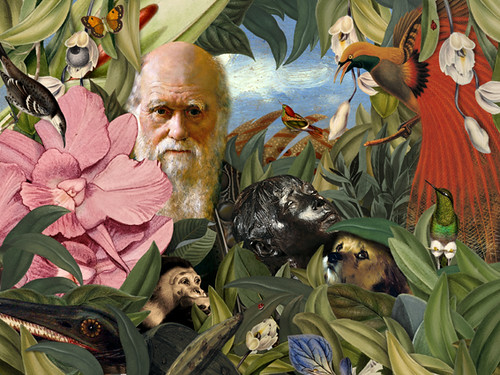
Fascinating talk by Timothy Morton on fallacies of Nature as an organizing concept and on what in fact makes one being different from the next, or not ....
"The Ecological Thought and Object Oriented Ontology"
Xochi’s Tale
Is it my fault I’m part rat terrier, part
the kind of dog who lives in a lady’s lap?
I didn’t ask to be bottom mutt in the pack
that runs untamed through the twisted trash-strewn streets
in Xochiapulcho, I didn’t ask to be plucked
up by a pair of gringos. First they took
away my manhood. No more sweet reek
of bitches, no hot pursuits, no garbage rot.
When they packed up to go back to the USA
I thought they’d cry, then dump me out, but no.
Macho mestizo, my entry papers say.
Who dines in style and sleeps the sleep of kings
ought dream no more of his rowdy half-starved days ….
I dwell in heaven but without the wings.
-- Maxine Kumin
Thursday, June 10, 2010
On Animals
The beings known as animals hover at the corner of the separation of inside and outside generated by the idea of a world as a self-contained system. Strangely enough, thinking in terms of "world" often excludes animals -- beings who actually live there. For Edmund Husserl, animals are like deaf people, "abnormal." For Heidegger, animals lack of a sense of world (Weltarm). Or, more precisely, their sense of the world is this lack. In contrast, some ecological thinking wants to forget about the differences between humans and other animals, real or imagined, as soon as possible. This inverted speciesism celebrates "the more than human world" (Abram). For Percy Shelly, animals lose their cruelty just as humans begin to live a more pacifist existence. ... For Rilke or Levertov, post-Romantic poets keen to establish an environmental poetics, animals have an access to the "open" that is denied to humans, either entirely or as a result of bad training. It all depends how up close and personal you want to get. Levinas strove to exclude animals from his idea of contact with the "face" of the other as the basis of ethics. But he was haunted by the face of a dog who had looked at him, perhaps with kindness, in a Nazi prison camp.
Timothy Morton, Ecology without Nature (2007)
Timothy Morton, Ecology without Nature (2007)
Monday, April 26, 2010


Sunday, April 4, 2010
Miroslav Tichy's Camera #1
 gotta go see this guy's show at the ICP .... from here he looks both creepy and fascinating
Monday, March 22, 2010


Subscribe to:
Posts (Atom)
